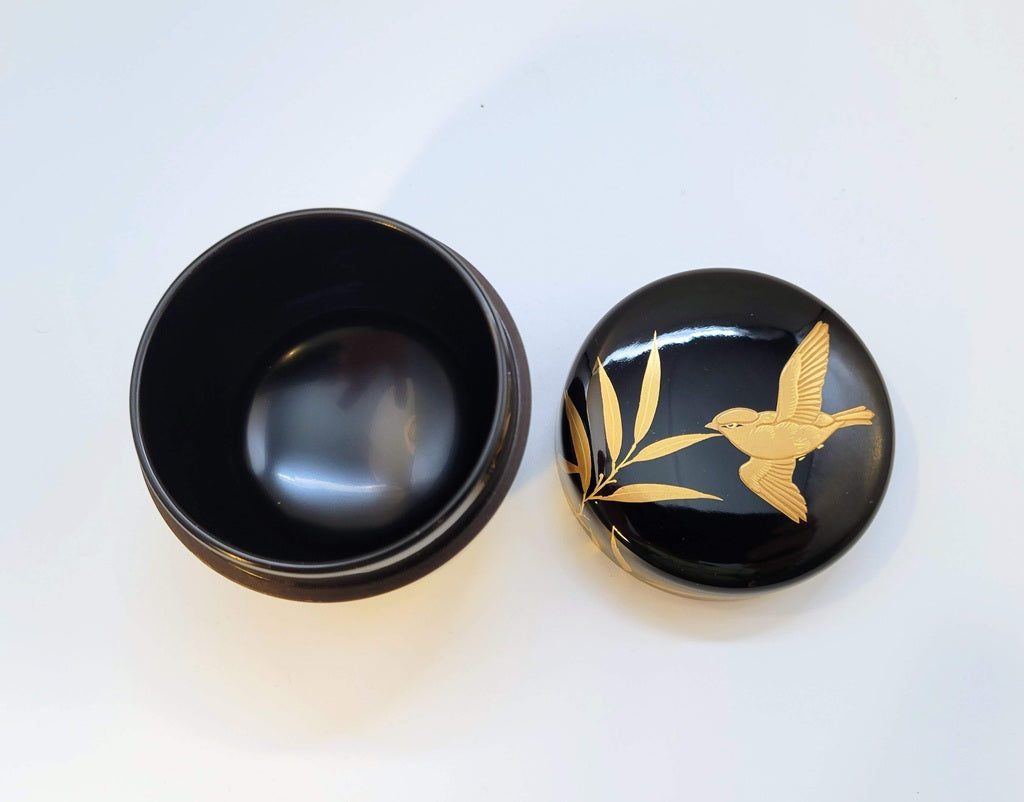
Japanese Natsume kachō-ga (花鳥画) bamboo and bird maki-e
Japanese Natsume kachō-ga (花鳥画) bamboo and bird maki-e
Couldn't load pickup availability
his Japanese natsume is crafted from wood and finished with deep black urushi lacquer. The surface is delicately adorned with a subtle maki-e motif of bamboo and a bird in flight—an image that brings together stillness, movement, and mindful attention.
The decoration follows the tradition of kachō-ga (花鳥画), a classical Japanese visual language in which flowers, plants, and birds are used to evoke a season or a fleeting moment. In this piece, the motif refers to spring: a time of new beginnings, gentle growth, and renewed awareness.
The bird is intentionally stylized rather than depicted as a specific species. Within the kachō-ga tradition, it symbolizes lightness and change, a fleeting moment that gains its value precisely because it passes. The bamboo forms a counterbalance: resilient, simple, and quietly growing. Together, they create a harmonious image that aligns with the rhythm of the tea ceremony and the spring season.
The maki-e decoration has a soft, warm sheen that reveals itself only as light moves gently across the surface. The form of the natsume sits comfortably in the hand, supporting the attentive opening, closing, and measuring of matcha.
This natsume is accompanied by a matching wooden storage box (awase-bako). It is suitable for use during the tea ceremony (usucha), but also well suited as a contemplative object in an interior where simplicity, nature, and attention are central.
- Japanese natsume (棗) for matcha
- Material: wood with black urushi lacquer
- Decoration: maki-e bamboo and stylized bird (kachō-ga)
- Diameter: approx. 6.9 cm
- Height: approx. 6.7 cm
- Seasonal symbolism: spring
- Includes matching wooden storage box (awase-bako)
- Suitable for tea ceremony (usucha) and display
- Condition: excellent; no visible cracks, scratches, or lacquer loss
- Origin: Japan
This natsume cannot be attributed to a specific lacquer artist. Many natsume were produced in small workshops throughout the 20th century, where craftsmanship and function were central. The absence of an artist’s name underscores the focus on form, material, and rhythm, the core values of Japanese tea culture.