Japanese Tea Caddy Yanagi 花鳥画 Willow Motif in Maki-e by Shunpō
Japanese Tea Caddy Yanagi 花鳥画 Willow Motif in Maki-e by Shunpō
Couldn't load pickup availability
This elegant natsume is finished in deep black urushi lacquer and finely decorated with a continuous willow motif (柳, yanagi) in gold maki-e. The long, flowing branches follow the curvature of the object in a natural way, creating a rhythm that subtly connects stillness and movement. The form is classical and well balanced, with a restrained appearance that accords with the traditions of the Japanese tea ceremony.
The Willow
Within Japanese aesthetics, the willow occupies a special place. It symbolizes flexibility, resilience, and impermanence: its branches bend with wind and rain without breaking. These qualities closely align with the values of chadō, emphasizing attentiveness, adaptability, and inner quiet. For centuries, the willow motif has therefore been used on natsume—objects that are not only functional but also contribute to the contemplative atmosphere of the tea moment.
Dew
Between the gold-colored willow branches, small, flat metal accents (hyōmon, 平文) are embedded in the lacquer. These details evoke dew or raindrops resting on the leaves. They catch the light in a subdued manner and add depth to the surface without disturbing the overall calm. The combination of maki-e and metal highlights the interplay between nature, time, and transience.
Swallows in Flight
On the inside of the natsume lid, two swallows (燕, tsubame) are depicted in gold maki-e. The birds appear to follow one another in flight, forming a light, almost hidden contrast to the restrained exterior.
In Japanese visual language, swallows symbolize spring, return, and a favorable future. Their placement on the inside is meaningful: the motif reveals itself only when the natsume is opened, as an intimate discovery visible solely to the person who actually uses the object. Within the tea ceremony, this reinforces the moment of transition—from closed to open, from preparation to mindful action.
Signature and Maker
The underside of the natsume is signed 春峰 (Shunpō) in red lacquer script. This signature corresponds with the attribution on the accompanying wooden box. Little biographical information about the maker Shunpō (春峰) has been preserved. The name appears as an artist’s signature on both the object and the tomobako. The signature, choice of materials, and use of motifs suggest a lacquer artist working within the traditional context of chadōgu, with an emphasis on classical symbolism and refined, understated decoration.
Tomobako
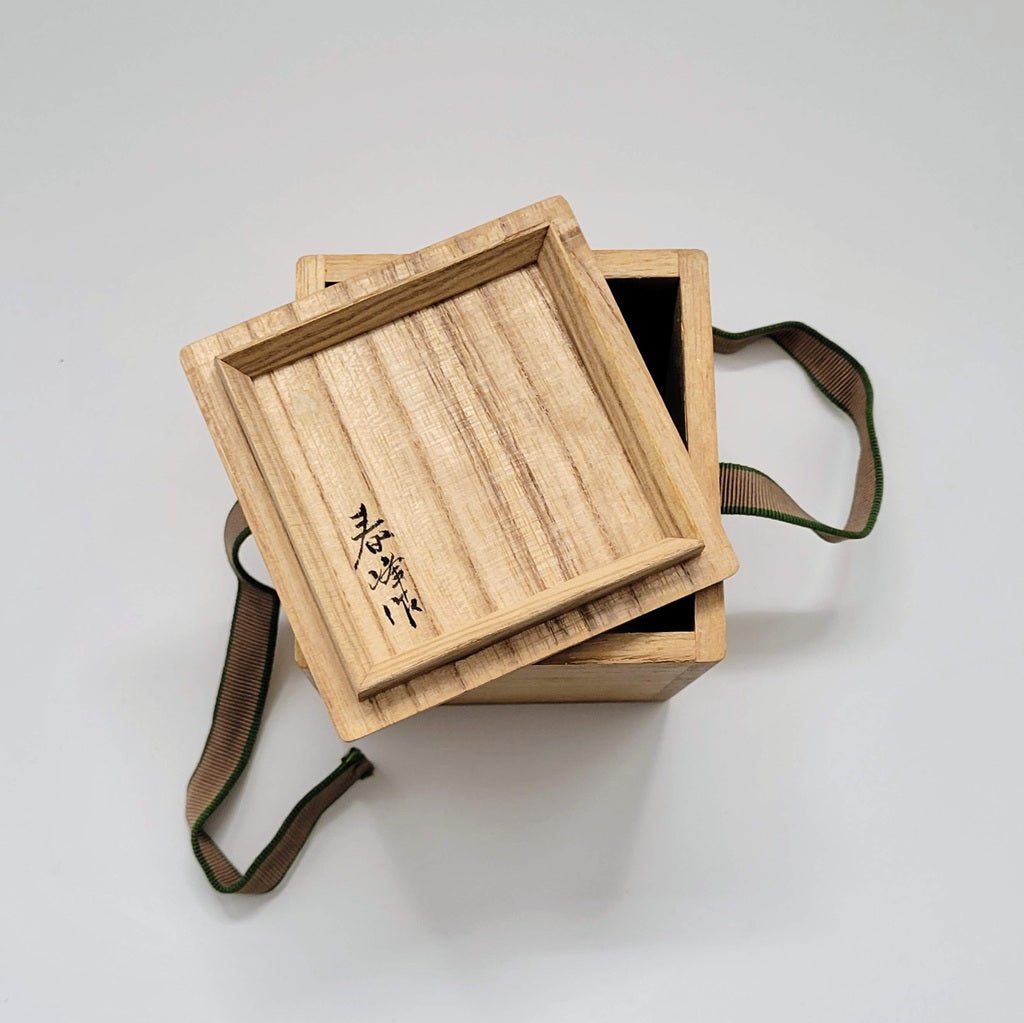
The natsume is accompanied by its original wooden tomobako. On the inside of the box lid is the handwritten inscription 春峰作 (Shunpō saku – “made by Shunpō”), indicating that the maker personally attributed the object. The combination of the signature on the object and the accompanying tomobako forms an important part of the identification and appreciation of Japanese lacquerware.
- Object: Natsume (棗) – matcha tea container
- Maker: Signed 春峰 (Shunpō)
- Technique: Urushi lacquer with maki-e and metal accents
- Motifs: Willows (柳蒔絵) and swallows (燕)
- Color: Black with gold decoration
- Signature: Underside of the natsume (red lacquer script)
- Box: Original tomobako with inscription 春峰作
- Origin: Japan
- Period: 20th century (more precise dating unknown)
- Condition: Used
The interplay of the flowing willow branches on the exterior, the dew-like metal accents, and the swallows on the interior makes this natsume an object with multiple layers of meaning. Designed for use within the tea ceremony, it also invites attentive observation. It is a natsume that evokes stillness and reveals itself fully only through the rhythm of opening, using, and closing.