Matcha sunkiri natsume 春野蒔絵 Hariya Yūsai
Matcha sunkiri natsume 春野蒔絵 Hariya Yūsai
Couldn't load pickup availability
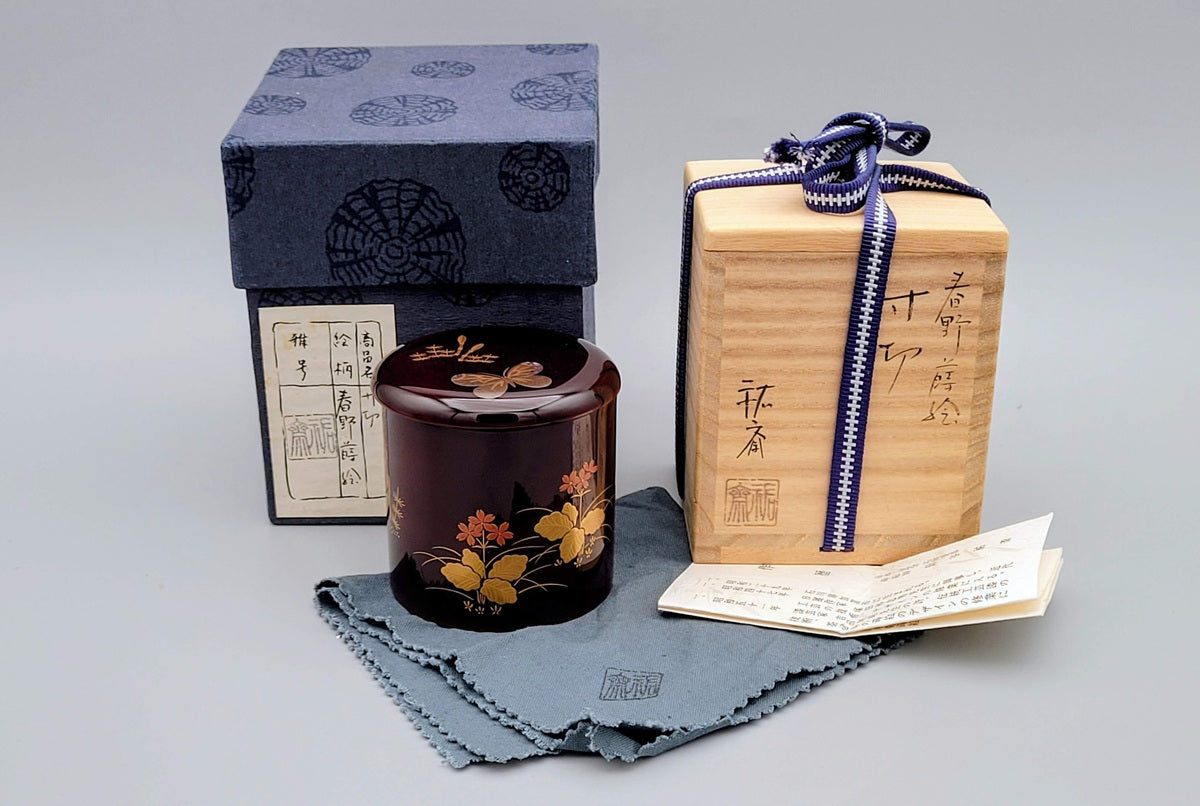
This beautiful natsume was created by the Japanese lacquer master Hariya Yūsai. The rounded shape is the sunkiri type (寸切棗), slightly lower and wider than the standard form, giving it a harmonious and stable appearance.
Motif
The surface is covered with multiple layers of transparent reddish-brown urushi lacquer (透漆, suki-urushi), creating a warm, deep gloss that subtly reveals the underlying layers. Over this, elegant motifs of spring plants (haruno)—including blooming wildflowers and ferns—have been applied in gold powder (金粉) and silver powder (maki-e). On the lid, a butterfly flutters, its wings inlaid with mother-of-pearl (raden 螺鈿), symbolizing grace, lightness, and rebirth.
The decoration is executed in the classical togidashi-maki-e technique, in which the lacquer is polished after the application of metal powders and mother-of-pearl until a smooth, even gloss is achieved. This is a time-consuming and demanding process practiced only by highly skilled masters.
Symbolism
Haruno (春野) literally means “spring field” (春 haru = spring, 野 no = field). In the name of an object, it refers to the decorative theme—often spring plants and flowers. The butterfly (蝶) in Japan represents elegance, transformation, and happiness. The spring plants (春野) symbolize the awakening of nature and renewal. Together, they express the tea ceremony ideal of wabi-sabi: beauty in simplicity, transience, and renewal.
Object details
- Title: Haruno makie sunkiri natsume (春野蒔絵寸切棗)
- Creator : Hariya Yūsai (針谷裕斎)
- Period Late Showa to early Heisei (ca. 1980–2000)
- Technology Urushi lacquer, gold and silver lacquer, raden (mother-of-pearl inlay)
- Format Sunkiri type (low & wide)
- Dimensions approx. Ø 6.5 cm × H 6.0 cm
- Material Wood core with natural urushi lacquer
- Motive Butterfly and spring plants (haruno)
- Includes: Original tomobako with signature
- Includes: fukusa cloth, paper outer box
- Condition: Excellent, no cracks, scratches or paint loss visible
- Origin Japan (Yamanaka Shikki tradition)
Tomobako and Authenticity
The piece is presented in its original tomobako (共箱), the wooden storage box inscribed with the title 春野蒔絵 寸切 (“Haruno maki-e sunkiri”) and the signature 裕斎 作 (“made by Yūsai”), along with his seal (印). It also includes the original silk fukusa cloth, likewise bearing the lacquer master’s seal, and a blue paper outer wrapper with the atelier’s label.
Signature and Maker
Hariya Yūsai (裕斎) is the artist name of Masayuki Hariya. The character Yū (裕) signifies abundance or richness, while Sai (斎) refers to a studio or place of dedication. Together, the name symbolizes his atelier of creative devotion and reflects his commitment to the art of maki-e and traditional lacquerware.
Hariya Yūsai is a contemporary master lacquer artist within the Yamanaka Shikki (山中漆器) tradition in Ishikawa Prefecture. He was born in 1954 in Kaga and remains active today as a maki-e artist. His work is distinguished by a refined combination of classical Japanese lacquer techniques and elegant, nature-inspired motifs.
He has received numerous awards, including the Technical Prize of the Creative Exhibition (1983 and 1989) and the Encouragement Prize of the Ishikawa Traditional Industry Promotion Council (1987). He has also been selected for the Hokuriku Seiun Exhibition and the Hanamachi Art Exhibition, among others.
Bio
- 1954 (Showa 29) – Born in Kaga City, Ishikawa Prefecture.
- 1972 (Showa 47) – Studied with Hashida Soto-o, a craftsman from Nitten (Japan Fine Arts Exhibition), learning modern craft techniques and design.
- 1976 (Showa 51) – Further training with lacquer artist Jiyuda Akira, focusing on traditional lacquerware and tea ceremony items.
Awards & Exhibitions
- 1983 (Showa 58) – Technical Award, Creative Exhibition
- 1986 (Showa 61) – Effort Award, Creative Exhibition
- 1987 (Showa 62) – Encouragement Award from the Ishikawa Traditional Industry Promotion Council
- 1989 (Heisei 1) – Technical Prize, Creative Exhibition
Participation in Exhibitions:
- Ishikawa Exhibition
- Chunichi Exhibition
- Hokuriku Women's Art Exhibition
- Three-Person Exhibition, etc.
Other Prizes:
- Encouragement Award, Autumn Creative Exhibition
- Encouragement Award, Spring Creative Exhibition
- Selected for the Hokuriku Seiun Exhibition
- Selected for the Hanamachi Art Exhibition
Representative Works
- Togidashi Maki-e
- Raised (Takamakie) Flower Motif Maki-e
- Flowing Water & Plovers (Chidori) Maki-e
In addition, he received the Maki-e Mounting Association Prize at the Tankosha 40th Anniversary Exhibition “Tea Ceremony Art for the Future”.