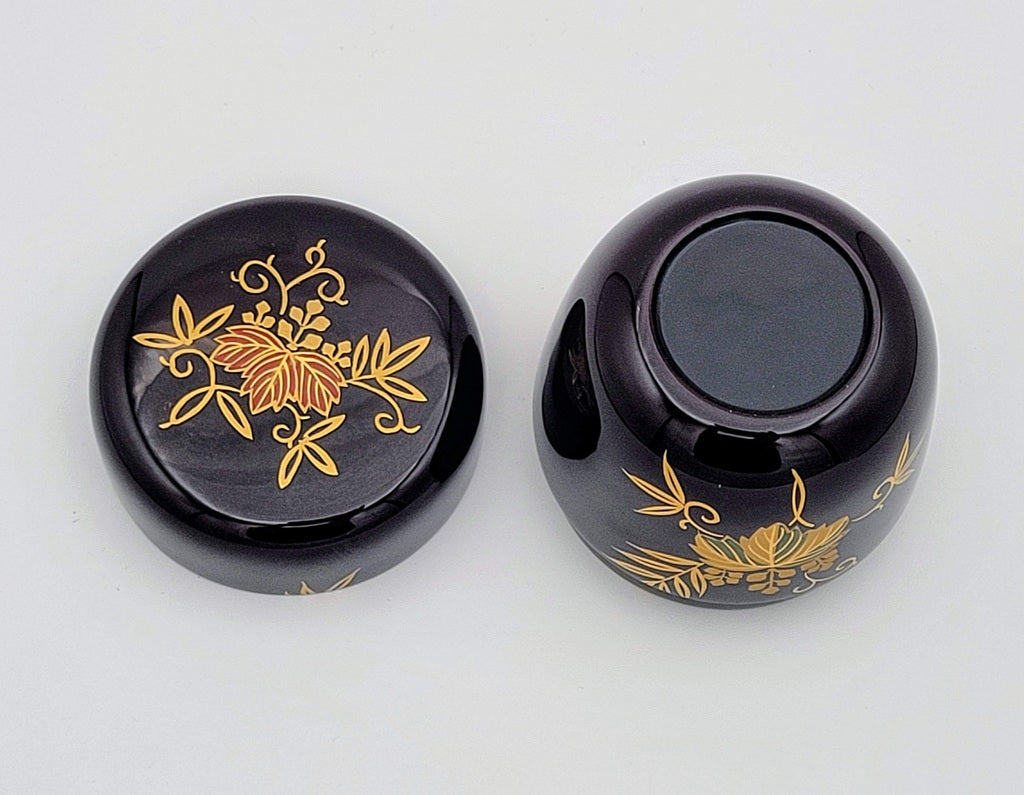
Natsume Sasa Kiri 笹桐 Miyata Munekage
Natsume Sasa Kiri 笹桐 Miyata Munekage
Couldn't load pickup availability
This natsume is finished in deep, glossy black urushi and decorated with subtle maki-e lacquer. The design features the classical sasa–kiri motif: bamboo leaves and paulownia. The bamboo leaf symbolizes purity and resilience. It bends with wind and rain without breaking and is therefore seen as a sign of inner strength and steadfastness.
Symbology
The paulownia tree, by contrast, has long been associated with the imperial court and has historically appeared in family crests. It represents dignity, protection, and continuity. According to tradition, the mythical phoenix nests only in the paulownia tree, which gives the motif an additional meaning as a symbol of harmony and prosperity.
Together these two motifs form a balanced and meaningful composition that aligns perfectly with the restrained beauty, symbolism, and contemplative nature of the Japanese tea ceremony. The natsume is presented in its original wooden tomobako with calligraphy, as is customary in Japan, forming a complete and authentic set.
Object details
- Title: Sasa Kiri 笹桐
- Creator : Miyata Munekage 宮田宗景
- Period : Showa (ca. 1975–1990)
- Technology Urushi lacquer with hiramaki-e
- Dimensions approx. Ø 6.5 cm × H 6.0 cm
- Material Wood core with natural urushi lacquer
- Includes: Original tomobako with signature
- Condition: Very good. The urushi surface and maki-e are bright and intact, with only minimal marks consistent with careful use.
- Origin Japan, Echizen (越前), Fukui Prefecture, Kawada (河和田), Sabae
Signature and maker
This natsume was created by Miyata Munekage (宮田宗景), a Japanese lacquer artist from the Echizen region in Fukui Prefecture. His workshop is located in Sabae, in the Kawada district, the historic center of the Echizen urushi tradition.
Miyata Munekage began his training in Shōwa 45 (1970) under Yōrin Issei (養輪一星) and began working independently in Shōwa 50 (1975). Such details are traditionally included with chadōgu (tea ceremony objects) and contribute to the historical context and appreciation of the piece. Catalogs and trade descriptions also frequently mention distinctions and selections, such as the Shitsugei Kyōkai Prize, selections or awards at the Nichigei-ten, and participation in the Echizen Maki-e Mihon-ichi exhibition. These references confirm his place within the Japanese lacquer tradition and his reputation as a maker of carefully executed, functional, and aesthetically balanced tea ceremony objects.
As a gift
This natsume makes a meaningful gift for the completion of studies, the awarding of a diploma, or the achievement of a certification. It marks a transition and invites its owner to move forward with calm and focus. The sasa–kiri motif reinforces this symbolism: the bamboo leaf represents flexibility and inner strength, while the paulownia stands for dignity and the ability to carry responsibility. Together they symbolize a new beginning — honoring what has been learned and looking ahead with confidence.