Matcha natsume Daiun 大雲 Saijō Issai
Matcha natsume Daiun 大雲 Saijō Issai
Couldn't load pickup availability
This exceptional Ōnatsume bears the name “Daiun” (大雲, Great Cloud), a poetic reference to serenity and the flowing harmony between heaven and earth. The piece was created in the atelier of Saijō Issai (西條一斉), a master lacquer artist from Nara, and reflects refined craftsmanship and a deeply rooted aesthetic tradition.
Motif
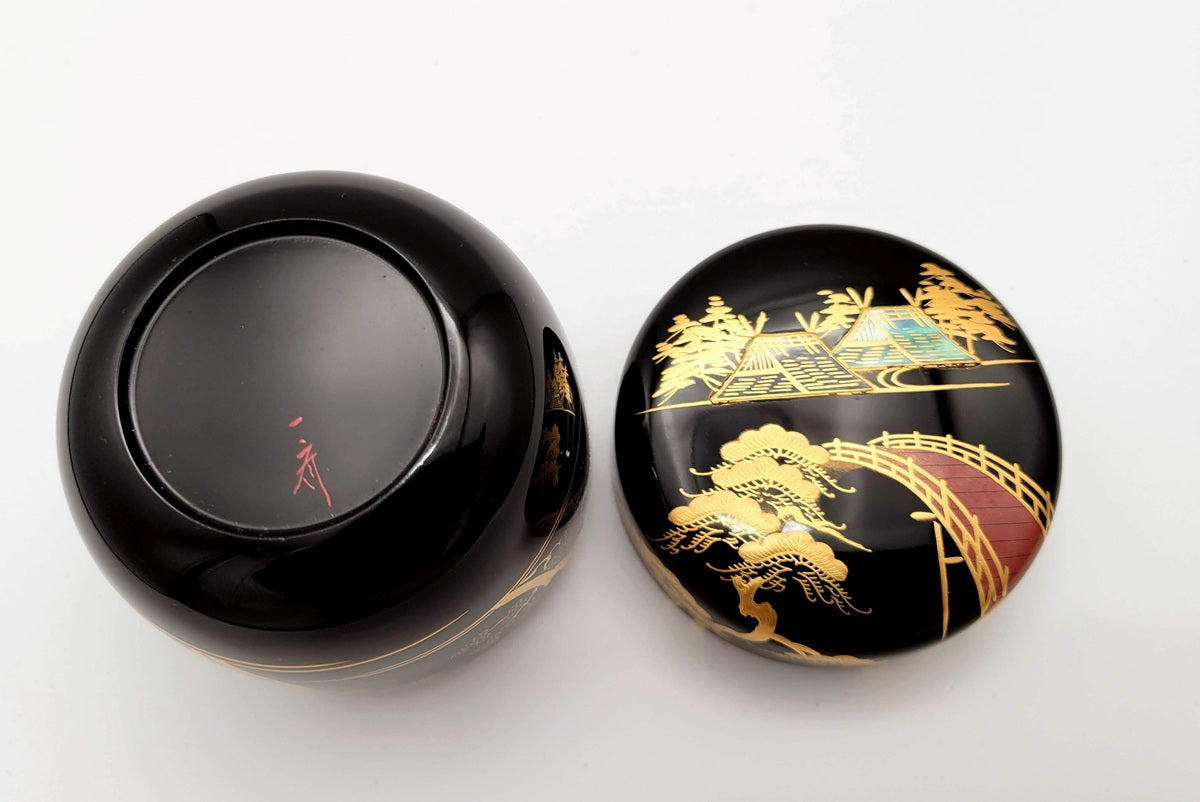
The motif depicts the Sumiyoshi-taisha Shrine (住吉大社) in Osaka, one of Japan’s oldest Shinto shrines, recognizable by the characteristic Sorihashi Bridge, which arches gracefully over the water. The bright red bridge contrasts with the surrounding pine trees, traditionally symbols of endurance and steadfastness. Together, they form an iconic landscape often associated with protection and purification. The scene is rendered in deep black urushi lacquer, enhanced with maki-e in gold powder and vermilion accents, giving the composition a subtle luster and sense of spatial depth.
Symbology
The symbolism is reinforced by the name “Daiun – Sumiyoshi”, chosen by the maker himself. “Daiun” (大雲, Great Cloud) evokes stillness and the gentle, free movement of a cloud across the sky—a metaphor for the state of mind during the tea ceremony. “Sumiyoshi” serves as the earthly counterpart: a tangible sacred site embodying tradition, protection, and cultural continuity. Together, they express the harmony between heaven and earth, between inner calm and ritual action—a balance that lies at the heart of chanoyu aesthetics.
- Creator: Saijō Issai (西條一斉)
- Title: Daiun Sumiyoshi (大雲)
- Type: Ōnatsume
- Materials: wood, rushi, urushi lacquer, maki-e (powdered gold & vermilion)
- Diameter: ≈ 7.2 cm
- Height: ≈ 7.5 cm
- Inscriptions: Signed 「斉」(Sai) by Saijō in red lacquer
- Inscriptions: Saijō Issai (box), Ikkō saku (box lid interior)
- Condition: Superficial traces of use.
- Accessories: Original tomobako with hanko, calligraphy.
Tomobako and Authenticity
The original tomobako (wooden presentation box) is inscribed with a brush: “Made by maki-e master Saijō Issai Ōnatsume Sumiyoshi.” Inside is the signature 「一高作」 (Ikkō saku), indicating that it was executed within the same atelier, most likely by a family member or student of Issai. This dual signature is characteristic of Japanese urushi workshops, where master and apprentice together represent a single artistic lineage.
Signature and Maker
Saijō Issai (b. 1937, Osaka; real name Okutsu Yoshimine, 奥津義峰) is a Japanese master of maki-e lacquerwork. He learned the craft from his father, Okutsu Yōhō (奥津洋方), and from the 1950s became active in the tradition of fine urushi art. From the 1960s onward, he was repeatedly selected for the Japan Traditional Crafts Exhibition (日本伝統工芸展) and its regional Kinki section. In 1989, he was appointed director of the Osaka Crafts Association (大阪工芸協会) and received several awards for cultural and craft achievements, including the Osaka Prefecture Cultural Merit Award in 1993. His atelier is located in Nara, where he continues his work in the spirit of refined tea ceremony aesthetics and classical Japanese design.